Definition:
A search engine is a system that retrieves and displays relevant information based on a user’s query.
What is a Search Engine?
Search Engine is an online tools that allows users to search for online content by using keywords. One of the well-known search engine is Google.
When a user enters a query into a search engine, the search engine results page (SERP) displays the most relevant pages that rank highly for that keyword.
How Search Engines Work in SEO (Step-by-Step)
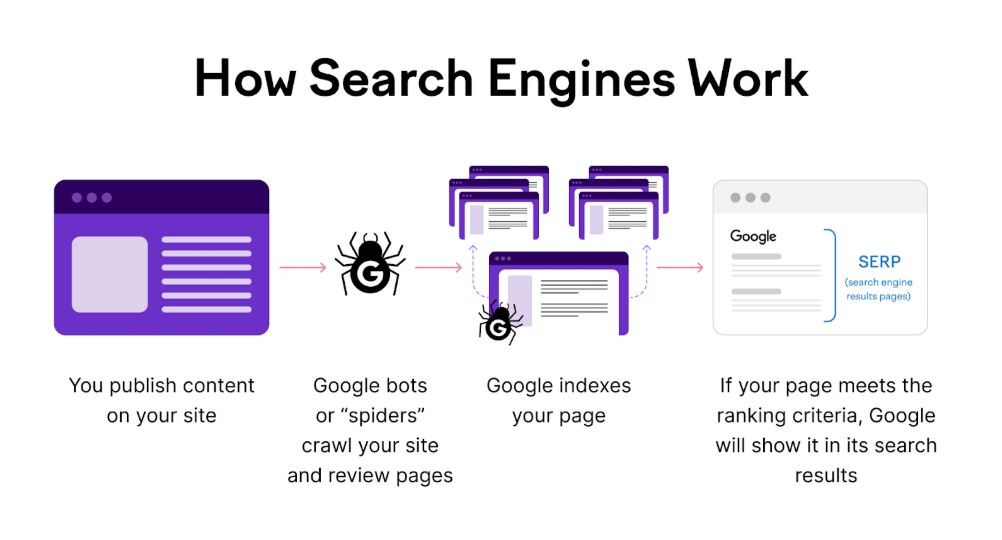
Search engines work through three main components: crawling, indexing, and ranking, to deliver the most relevant results to users. For example, when a user searches for a long-tail keyword such as “what are the best SEO tips for small businesses,” the search engine analyzes the search intent and returns the most relevant, high-quality content pages.
Crawling
Search engines use web crawlers, also known as ‘spiders’ or ‘bots,’ to crawl and explore websites. Crawling means scanning web pages to discover content. These crawlers follow links from one page to another by following internal links to find new and updated content from homepage or sitemap.
It is important to properly link your pages, as crawlers may not be able to explore them effectively if they are not linked or are blocked.
Example:
- Ensure that your blog post is linked together in order to allow web crawler to crawl your website efficiently. For example, “How search engine works” blog can link to “search intent” as it able to relate.
Indexing
Indexing is when search engines store and organize the content they have crawled earlier. To help you visualize this, think of it as a huge library where books are categorized by topic. In this case, web pages that are well-structured and contain relevant keywords are more likely to be indexed properly.
Example:
- When Google crawls your page about “How search engines work”, it scans the content and stores it so it can be shown to users in search results when it is relevant.
Ranking
Search engines rank indexed web pages based on their relevance, authority, and user experience. When a user enters a query, the search engine displays the top pages that best match the search intent on the results page.
Key factors that influence how pages rank:
- Relevant keywords
- High-quality backlinks
- Mobile responsiveness
- Fast loading speed
- Strong user engagement
Organizing Web Content
Search engines use quality, relevancy, and structural analysis to arrange web material. For instance, search engines may more easily comprehend a well-organized website with distinct headings, internal links, and excellent content.
Example:
- A website is more likely to be correctly indexed and ranked if it has clear H2 sections, optimized keywords, and relevant internal links.
What Prevents a Page from Getting Indexed?
Not all pages get indexed. If your content is too thin, duplicated, or blocked by a noindex tag, it may be excluded from the index.
Examples of common pages that may not be indexed include:
Low Quality Content
- Too short or not detail enough
- Not much unique information
Duplicate Content
- Pages that are similar to your other pages or to your competitors’ content.
Weak Internal Link
- Page is not linked well
- Google assume as less important
Search Intent Not Match
- Does not fulfill what users looking for
- Google think it is not relevant and not the best result
How to Get Indexed by Google
To get indexed, ensure that your website follows SEO best practices, including proper internal linking and the absence of broken links, so it can be easily crawled. This helps pages get indexed automatically, or you can submit your sitemap to Google Search Console to help Google discover your pages faster.
Few Beginners Tips to Improve Your Website for Search Engines
- Use clear headings (H1, H2, H3) to improve indexing
- Optimize meta titles and descriptions to improve click-through rate
- Use internal links to help search engine spiders crawl and explore your site
- Focus on creating high-quality content that satisfies search intent
- Use SEO tools like Google Search Console to monitor performance
Frequently Asked Questions
Why is my website not indexed?
Possible reasons include noindex tags, poor content, or lack of internal links.
How long does it take Google to index a page?
It can take a few hours to several weeks.
Do search engines understand images and videos?
Yes, but they rely on alt text, metadata, and structured data.
How do search engines find websites?
Search engines use bots to crawl links across the internet.